
If your employer has offered you a 2%, 3%, 4% or 5% pay rise, it is natural to ask whether that is “good”. The difficulty is that there is no single correct percentage. A raise can be above the national average and still be poor for your role, or below the national average and still make sense in a sector where wages are moving more slowly.
The most useful approach is to compare your increase in layers: national wage growth, your sector, inflation, your market rate and the change in your own responsibilities. This guide walks through each one.
What is the average UK pay rise in 2026?
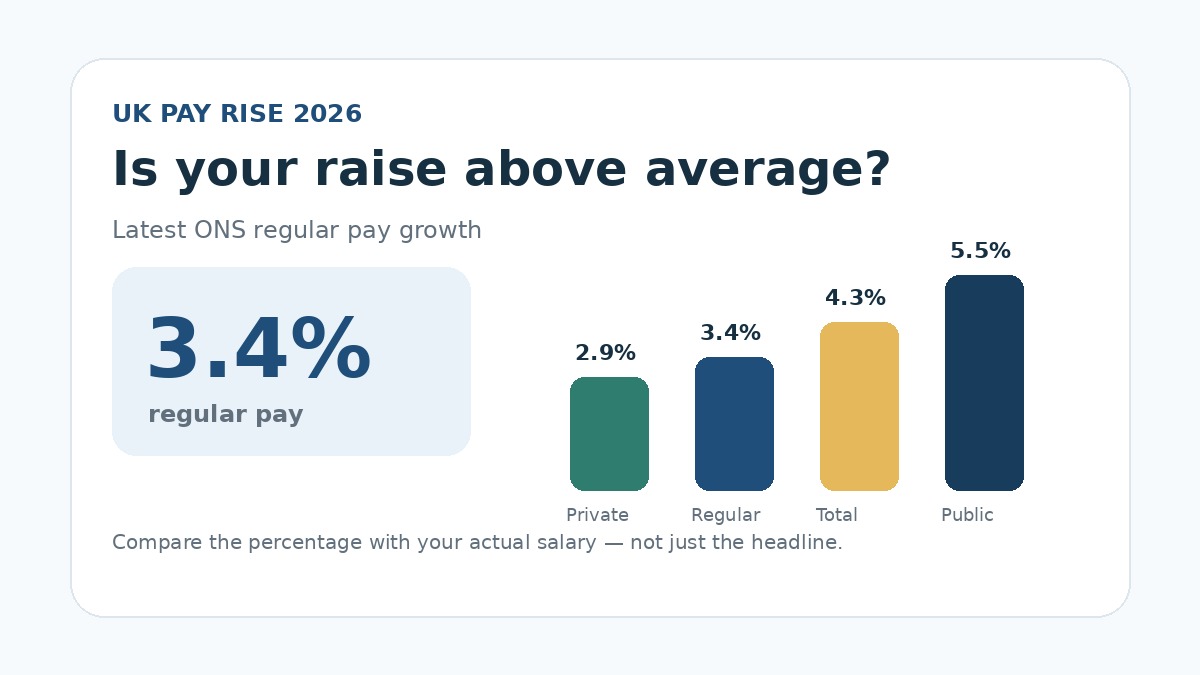
There is no official statistic called “the average pay rise”. The Office for National Statistics instead measures how average earnings change across employees. In the latest release available when this guide was published, covering March to May 2026, annual growth was 3.4% for regular earnings and 4.3% for total earnings.
The distinction matters. Regular earnings exclude bonuses, so 3.4% is usually the cleaner benchmark if you are comparing a permanent base-salary increase. Total earnings can jump around more because bonus payments vary by sector and timing.
The ONS also reported a large difference between sectors: average regular earnings growth was 5.5% in the public sector and 2.9% in the private sector. The ONS cautions that public-sector growth in 2026 is affected by the timing of pay awards, so these numbers should be treated as context rather than a target for an individual negotiation.
What does a 2.9%, 3.4%, 4.3% or 5.5% rise mean in pounds?
Percentages are easy to discuss and surprisingly hard to feel. Converting the raise into annual and monthly money makes the offer much easier to judge.
| Current salary | After 2.9% | After 3.4% | After 4.3% | After 5.5% |
|---|---|---|---|---|
| £25,000 | £25,725 | £25,850 | £26,075 | £26,375 |
| £30,000 | £30,870 | £31,020 | £31,290 | £31,650 |
| £40,000 | £41,160 | £41,360 | £41,720 | £42,200 |
| £50,000 | £51,450 | £51,700 | £52,150 | £52,750 |
For example, a 3.4% raise on £30,000 takes the annual salary to £31,020. That is £1,020 more per year, or £85 more per month before tax and other deductions. On £50,000, the same percentage takes the salary to £51,700—£1,700 more per year.
Calculate your exact pay rise
Enter your current pay and percentage to see the new hourly, weekly, monthly and annual figures.
So, is a 3%, 4% or 5% pay rise good in 2026?
A useful first check is to compare it with the latest 3.4% regular-pay growth figure. On that basis alone, a 3% increase is slightly below the current headline, 4% is slightly above it and 5% is clearly above it. But stopping there can lead to the wrong conclusion.
1. Compare the new salary, not just the percentage
A 5% raise sounds stronger than a 3% raise, but if you were already materially underpaid, even 5% may leave you below the current market range. Search for comparable roles with similar responsibilities, location, seniority and company size. The relevant question is not only how much your old salary changed—it is where your new salary sits.
2. Separate promotion increases from ordinary annual reviews
If your job title, accountability or scope has materially expanded, a standard annual increase may not be the right benchmark. A promotion or major change in duties is better compared with the salary range for the new level of work.
3. Compare the rise with inflation
A nominal pay rise tells you how many more pounds you receive. Inflation tells you how quickly prices are changing. The latest CPI reading was 2.6% in the 12 months to June 2026, so a raise above that level would, in a simple sense, be ahead of that inflation measure. For the more accurate calculation, see our pay rise vs inflation 2026 guide.
4. Look at your evidence
If you now manage a larger budget, lead people, own a system, cover a wider territory, have gained a qualification or consistently deliver results that were not expected when your salary was set, your personal case may justify more than the national average.
A better 5-question test for your pay rise
Use this before accepting or negotiating
- New salary: What exact annual and monthly amount will I receive?
- Market: Where does that new salary sit against comparable vacancies and salary ranges?
- Inflation: Is the increase ahead of or behind the latest inflation rate?
- Role: Have my responsibilities grown enough that I should be comparing myself with a higher-level role?
- Total package: Are bonus, pension, leave, flexibility or other benefits changing too?
This prevents a common mistake: celebrating a percentage without checking the destination. A 4% rise from £28,000 to £29,120 may be useful, but if comparable roles are routinely offered around £33,000, the market gap matters more than whether 4% beats the national wage-growth headline.
What if your pay rise is below average?
Being below 3.4% does not automatically mean your employer is underpaying you. Your sector may be growing more slowly, your salary may already be high within the band, or the business may use a different review cycle. But it gives you a reasonable prompt to ask better questions.
Instead of saying “the national average is 3.4%, so I should get 3.4%”, try: “I have looked at current wage growth and comparable roles. Can you explain how my increase was determined and where my new salary sits within the range for my role?”
If you decide to negotiate, our 7-step guide to asking for a pay rise shows how to build the evidence and structure the conversation without turning it into a confrontation.
Why 18 August 2026 matters
The ONS is scheduled to publish its next average weekly earnings update on 18 August 2026. That creates a useful moment to re-check the benchmark, especially if you have a salary review coming up. The headline can move in either direction, so do not build an entire negotiation around one month of data.
RepeatLift will treat the newest official release as context, not a prediction. Your own salary decision still needs role-specific evidence.
Sources and methodology
- Office for National Statistics — Average weekly earnings in Great Britain: July 2026, released 21 July 2026.
- ONS EARN01 dataset, which lists the next release for 18 August 2026.
Figures are national averages and are not a personalised salary recommendation. Calculator examples show gross pay before tax, pension and other deductions.
Frequently asked questions
What is the average UK pay rise in 2026?
There is no single official “average pay rise” statistic. The latest ONS data available on 13 August 2026 shows annual growth of 3.4% in regular earnings and 4.3% in total earnings for March to May 2026.
Is a 5% pay rise good in 2026?
Five per cent is above the latest 3.4% regular-pay growth figure and above the latest 2.6% CPI inflation rate, but you should also compare the resulting salary with your role's current market range.
Is a 3% pay rise bad?
Not necessarily. It is slightly below the latest national regular-pay growth figure, but sector, salary band, role scope and total benefits can all change the interpretation.
How do I calculate a pay rise?
Multiply your current pay by one plus the percentage expressed as a decimal. For a 4% rise on £30,000: £30,000 × 1.04 = £31,200. The RepeatLift calculator does this across hourly, weekly, monthly and annual pay.