
When someone says “I got a 4% pay rise”, there are really two questions hiding inside the sentence. First: how much more money will appear in the gross salary? Second: after prices have risen, how much more can that salary actually buy?
The second question is why comparing your pay rise with inflation is useful. It turns a nominal increase into a more realistic picture of whether your purchasing power improved.
What is UK inflation right now?
The latest Office for National Statistics data available when this article was published shows that the Consumer Prices Index (CPI) rose 2.6% in the 12 months to June 2026. CPIH—which also includes owner occupiers' housing costs—rose 2.8%.
Those figures are national averages. Your own household can feel very different depending on how much you spend on rent or mortgage costs, energy, food, transport, childcare and other items. Inflation is therefore a benchmark for purchasing power, not a personal cost-of-living statement.
How to calculate whether your pay rise beat inflation
A quick mental check is to subtract inflation from your raise. A 4% raise minus 2.6% inflation gives 1.4 percentage points. That is useful for a rough comparison, but it is not the exact real increase.
(1 + pay rise) ÷ (1 + inflation) − 1
For a 4% pay rise and 2.6% inflation: 1.04 ÷ 1.026 − 1 ≈ 1.4% real growth.
Why divide instead of subtract? Because your salary and the price level are both compounding from their previous values. At small percentages the difference is modest, but the formula is the cleaner way to think about real purchasing power.
What different pay rises mean with 2.6% inflation
| Pay rise | Approx. real change | Interpretation |
|---|---|---|
| 2.0% | -0.6% | Loses purchasing power |
| 2.6% | +0.0% | Roughly keeps pace |
| 3.0% | +0.4% | Gains purchasing power |
| 3.4% | +0.8% | Gains purchasing power |
| 4.0% | +1.4% | Gains purchasing power |
| 5.0% | +2.3% | Gains purchasing power |
| 10.0% | +7.2% | Gains purchasing power |
At the current 2.6% CPI rate, a 2% raise would leave purchasing power slightly lower on this national measure. A 3.4% raise—the latest regular-earnings growth figure—would be modestly ahead. A 5% increase would produce a clearer real gain.
A real salary example: £35,000 with a 4% rise
Start with a salary of £35,000. A 4% increase takes it to £36,400, an extra £1,400 per year before deductions.
If prices are 2.6% higher, a salary of about £35,910 would be needed simply to match that CPI increase in cash terms. The £36,400 salary is £490 above that inflation-matching amount. That does not mean you literally have £490 “extra” to spend—the tax system and your own spending basket matter—but it gives you a concrete way to visualise the difference.
Turn your raise into actual money
Calculate the new salary first, then compare that percentage with inflation and your market rate.
How does average pay compare with inflation in 2026?
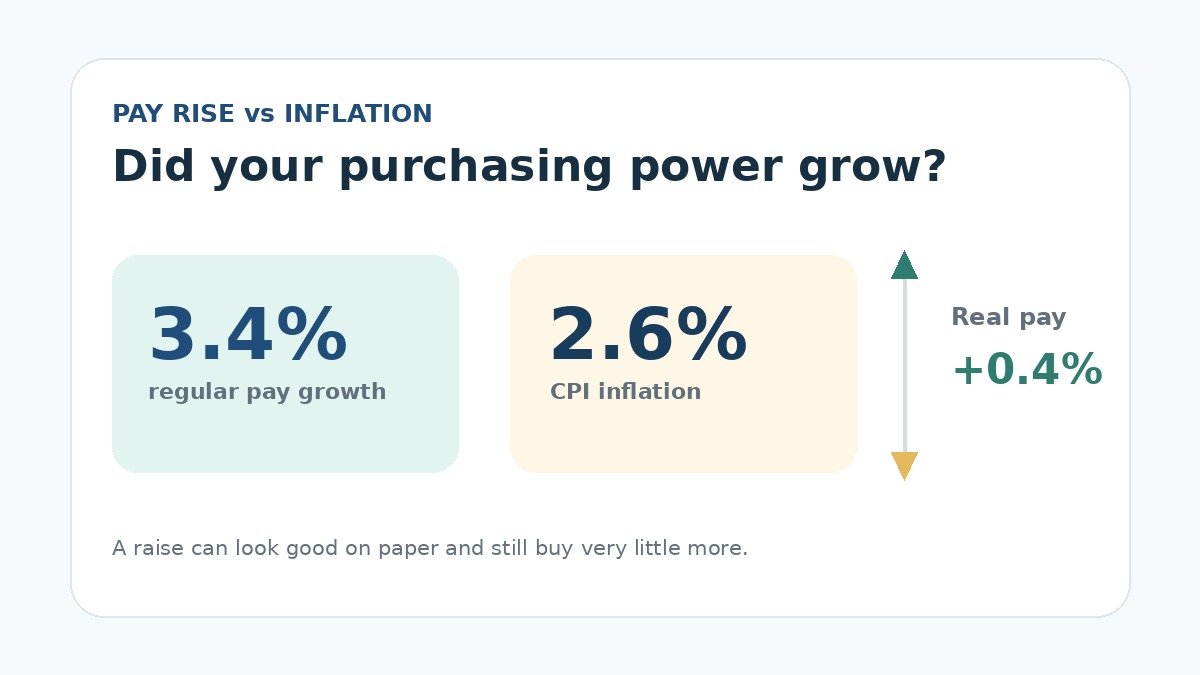
The latest ONS earnings release reported annual growth of 3.4% for regular pay in March to May 2026. In real terms, using CPI, the ONS estimated regular pay growth at 0.4%. Using CPIH, it was 0.3%.
This is an important distinction. Headlines about wages “rising 3.4%” describe nominal growth. The real-terms figure answers a different question: how much wage growth remains after adjusting for price increases.
For an individual worker, neither figure tells you what you personally should earn. It simply gives context for a salary review.
Why your personal inflation can feel higher
CPI is built from a broad basket of goods and services across the economy. Your budget is not that basket. If a large share of your income goes to a category whose price rose faster than the average, your lived experience can be tougher even while the national inflation rate falls.
That is why a pay review is best judged using three lenses:
- Purchasing power: did your raise broadly keep pace with inflation?
- Market value: does your new salary match comparable roles?
- Contribution: has your scope, performance or responsibility increased?
Inflation is useful evidence, but it is rarely the strongest argument on its own. Employers usually have more control over role bands, market benchmarking, performance and retention than over your personal household costs.
How to use inflation in a pay review without making a weak argument
Avoid opening with: “My bills went up, so I need a raise.” That is understandable personally but gives the employer little basis for deciding what your role is worth.
A stronger version is: “My responsibilities have expanded in these areas, comparable roles are currently around this range, and I would like to review whether my salary still reflects the role. I have also looked at current wage and inflation data so I understand the wider context.”
That keeps inflation in the conversation while anchoring the request in professional evidence. If you are preparing for that meeting, use our practical guide to asking for a pay rise.
What happens on 19 August 2026?
The ONS is scheduled to release the July 2026 consumer price inflation data at 7:00am on 19 August 2026. The CPI figure could rise, fall or remain unchanged. If you have a salary review after that date, use the newest official figure rather than relying on this June benchmark.
The point is not to chase every monthly movement. It is to use current data when making a decision that affects your pay.
Sources and methodology
- Office for National Statistics — Inflation and price indices, latest June 2026 CPI/CPIH data and next-release date.
- ONS — Average weekly earnings in Great Britain: July 2026.
Real-change examples use (1 + pay rise) ÷ (1 + CPI inflation) − 1. They are educational estimates, not personalised financial advice.
Frequently asked questions
Does a 3% pay rise beat inflation in 2026?
Against the latest 2.6% CPI inflation rate, a 3% raise is slightly ahead. Using the real-growth formula, the increase in purchasing power is about 0.4% before considering tax and your personal spending pattern.
What pay rise would exactly match 2.6% inflation?
A 2.6% nominal increase matches a 2.6% inflation rate in percentage terms. That does not guarantee every part of your personal budget is protected because individual prices move differently.
Should I use CPI or CPIH to compare my salary?
CPI is widely recognised and useful for a simple comparison. CPIH includes owner occupiers' housing costs and is the ONS headline inflation measure. Whichever you use, label it clearly and avoid mixing the two.
Why did my salary go up but I still feel worse off?
Your raise may be below inflation, deductions may have changed, or the items you personally buy may have risen faster than the national average. Compare the gross raise, take-home pay and your own budget separately.