
Black Friday can make almost any ecommerce dashboard look healthy. Traffic jumps. Orders jump. Revenue jumps. Then January arrives, the paid traffic is gone, the discount is gone, and you find out whether you acquired customers or simply rented a crowd for a weekend.
That is why this guide is not another list of “10 ways to retain Black Friday shoppers.” The useful question is more specific:
Once you know that number, your retention plan becomes easier to judge. You can decide whether a loyalty offer is worth funding, whether a post-purchase sequence deserves attention, whether your 30% discount is too deep, and which products should be used to acquire new customers in the first place.
Start with your own Black Friday numbers
Enter customer volume, average order value and a possible lift in repeat purchasing. The calculator shows the revenue attached to that improvement.
Why Black Friday customer retention matters more in 2026
The interesting thing about 2026 is not that Black Friday is disappearing. It is that the shopping journey around it is getting longer.
Optimove’s 2026 holiday survey found that 66% of respondents were willing to begin holiday shopping between July and October, yet 63% said they may wait for Black Friday or Cyber Monday when asked directly about those events. BigCommerce’s 2026 holiday analysis reaches a similar conclusion: shoppers are researching earlier, comparing more retailers and still using Cyber Five as a major conversion moment.
That matters for retention because many shoppers will arrive on Black Friday having already compared you with several alternatives. They are not necessarily loyal. They are simply ready to buy.
At the same time, 47% of Optimove’s respondents said they expect to explore new brands. That is excellent news for acquisition. It is also a warning: if your Black Friday strategy ends at checkout, you are doing the expensive part of the relationship and leaving the valuable part to chance.
There is another useful detail in the same research. When people were asked what drives holiday purchase decisions, quality ranked above price: 81% selected quality, 70% selected price, and only 23% selected promotions. That does not mean discounts are irrelevant — clearly they are not. It means the discount can open the door, but it cannot do all the retention work for you.
The one calculation to do before you choose your Black Friday discount
Most Black Friday planning starts with the first order:
- How much discount can we afford?
- What conversion rate do we need?
- What revenue target are we chasing?
- How much can we spend on acquisition?
Add one more line to that planning sheet: the value of one extra wave of repeat purchases.
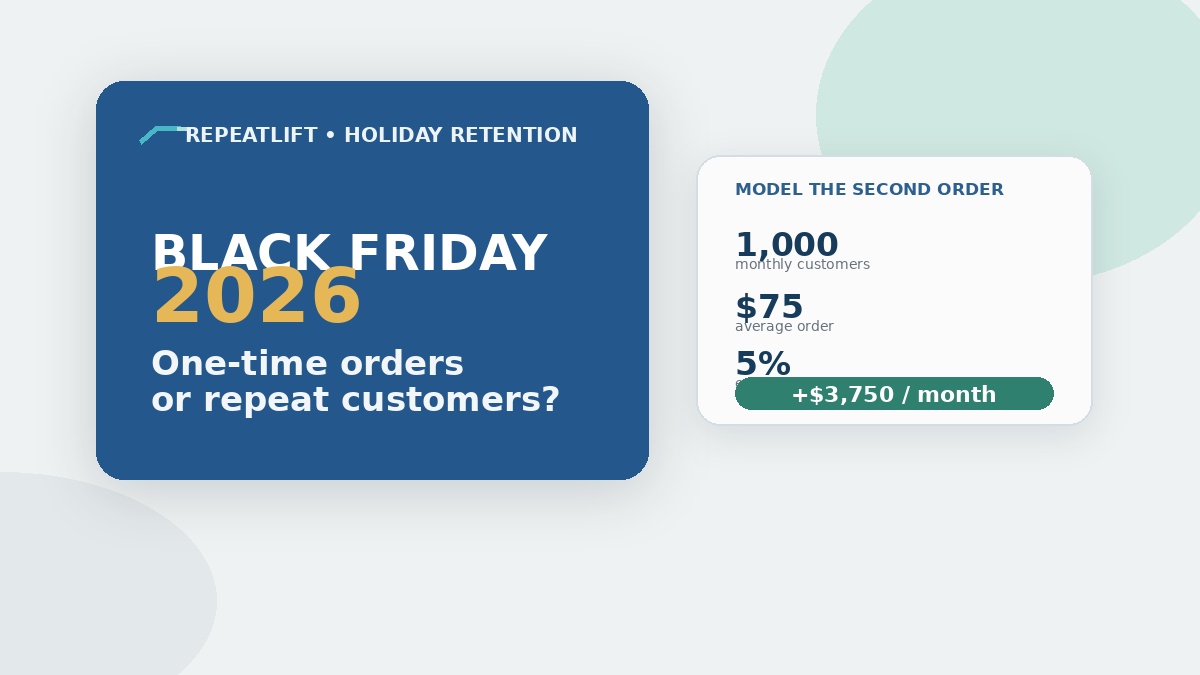
1,000 first-time customers × 5% additional repeat purchase rate × $75 average order value = $3,750 additional repeat revenue.
In plain English: if 50 more people come back once, and they spend roughly $75, that second-order lift is worth $3,750.
This is deliberately simpler than a full customer lifetime value model. That is the point. You do not need a perfect forecast to make a better Black Friday decision. You need a realistic scenario that tells you whether improving the second purchase is worth hundreds, thousands or tens of thousands to your store.
| Black Friday customers | Average order | Extra repeat lift | Extra second-order revenue |
|---|---|---|---|
| 500 | $60 | 3% | $900 |
| 1,000 | $75 | 5% | $3,750 |
| 2,500 | $80 | 7% | $14,000 |
| 10,000 | $65 | 5% | $32,500 |
Important: for a one-off Black Friday cohort, treat this as the value of an extra repeat-purchase wave. Do not automatically multiply it by 12. RepeatLift annualises recurring monthly scenarios, but a Black Friday cohort is seasonal unless similar customer volume and repeat behaviour continue every month.
Do not confuse revenue with a good Black Friday deal
A second order can look attractive in revenue terms and still be weak after discounts, product cost, fulfilment, returns, fees and paid acquisition.
Do not treat every Black Friday buyer as the same customer
This is where most “retention tips” become too generic. A person buying a three-month supply of skincare for themselves is not the same customer as someone buying a Christmas gift for their sister. They may both place a $75 order on 27 November, but the next logical purchase is completely different.
1. The deal hunter
They wanted the price. If the only reason to return is another 30% discount, you may have acquired a promotion-dependent buyer rather than a profitable repeat customer.
2. The first-time product believer
They discovered you because of Black Friday, but the product solves a recurring problem. This is the customer most likely to respond to education, replenishment timing and a sensible next product.
3. The gift buyer
They may never need the same product again. The better second-order angle could be self-purchase, another gifting occasion, referral or a different recipient — not “buy the same thing again.”
4. The existing customer waiting for the sale
They were already yours. Do not count their Black Friday order as successful acquisition. Measure whether the promotion increased basket size, frequency or margin without simply discounting a purchase they would have made anyway.
BigCommerce’s 2026 holiday playbook recommends separating first-time shoppers, returning customers, high-value customers and loyalty members rather than pushing the same campaign to everyone. That is not just a personalization tactic. It stops you from reading a mixed Black Friday customer base as if everyone has the same retention potential.
Choose the second purchase before you launch the first-order offer
A retention plan gets much stronger when you can finish this sentence:
If you cannot name the next purchase, a generic “come back and get 10% off” email will not fix the problem.
For replenishable products
Think coffee, skincare, pet supplies, supplements, household consumables or anything used up over time. The next order should be timed around expected depletion. The useful question is not “When should we send a coupon?” but “When is this customer likely to notice they are running out?”
For products with natural complements
If the first order creates an obvious next need — accessory, refill, care product, compatible item, bundle extension — build that into the post-purchase journey. Show the customer how the second item improves what they already bought instead of throwing a random bestseller at them.
For durable or high-ticket products
Repeat purchase may be slow. Do not force a monthly-retention model onto furniture, electronics or expensive equipment. Your next value event may be an accessory, service plan, consumable, referral, gift purchase or a return to the brand months later.
For gift-heavy categories
Black Friday gift buyers are particularly easy to misread. The recipient uses the product, but the purchaser owns the customer record. A good follow-up can bridge that gap with self-gifting, “shop for someone else,” referral, birthday reminders or a post-Christmas discovery offer. A bad follow-up assumes they personally need a refill for a product they never used.
A practical Black Friday retention plan: before, during and after BFCM
Before Black Friday: define the economics
Pull last year’s numbers if you have them. Separate new customers from returning customers and look at the products that attracted first-time buyers. Then calculate three scenarios: a conservative repeat lift, a realistic one and an ambitious one.
If 3% more repeat purchasing is barely worth anything, do not build an elaborate retention program around the assumption that it will rescue an unprofitable acquisition offer. If 5% is worth $20,000 to your store, then the post-purchase experience deserves to be designed with the same care as the Black Friday landing page.
During Black Friday: collect the information you will need later
Tag the acquisition source, first-time/returning status, product purchased, discount depth and order margin. If possible, identify whether the order looks like a gift purchase. You are building the cohort you will analyse in December and January.
Also protect the boring operational details. Shipping promises, stock accuracy, returns and support are not “after-sales admin.” They are part of retention. A first-time customer who spends five days chasing a missing parcel does not care how clever your loyalty flow is.
Immediately after purchase: do not ask for another order too soon
The first job of post-purchase communication is to reduce anxiety and help the customer feel good about the order they already placed. Confirmation, tracking, delivery clarity and useful product information come before the next promotion.
BigCommerce explicitly recommends scheduling post-purchase emails, review requests, loyalty offers and post-holiday promotions before the season begins. The useful part is the timing: build the sequence before the order spike, not after your team is already buried in fulfilment.
After delivery: earn the right to sell again
This is where the second-order path starts. Ask yourself what the customer knows now that they did not know at checkout. Have they used the product? Do they need help? Is there a natural complement? Is a replenishment window approaching? Did they buy a gift?
Then send the next message because it is relevant, not because “Day 14” exists in your automation template.
What not to do with Black Friday customers
Five expensive mistakes
- Send another blanket discount immediately. You teach new buyers that your normal price is optional.
- Call every Black Friday order a new-customer win. Existing customers waiting for a sale are not acquisition.
- Judge retention in seven days. Your normal purchase cycle may be 30, 60 or 180 days.
- Compare gift buyers with replenishment buyers. They entered for different reasons and need different next offers.
- Celebrate repeat revenue without checking margin. A second low-margin order is not automatically a good customer relationship.
How to measure Black Friday customer retention without fooling yourself
Do not compare “all Black Friday customers” with “all normal customers” and call it analysis. Build a clear cohort.
- Choose the cohort: first-time customers acquired during your BFCM window.
- Choose the observation window: 30, 60, 90 or more days based on your normal buying cycle.
- Measure second purchase rate: what percentage placed another order?
- Measure second-order AOV: did they spend at normal pricing or wait for another deal?
- Measure contribution margin: did the customer become more profitable after the first discounted order?
- Break results down by product and source: which acquisition offers produced customers who actually returned?
The product breakdown is often more useful than the overall repeat rate. You may discover that one “hero” Black Friday product generates huge first-order volume but almost no follow-on behaviour, while a smaller bundle creates customers who return reliably. That is the kind of information that should change your 2027 promotion strategy.
Black Friday 2026 retention timeline
Black Friday is 27 November 2026 and Cyber Monday is 30 November 2026. But 2026 research shows the consideration period is already stretching well before November. Digital Commerce 360 reported in August that retailers were already making decisions about holiday promotions, marketing, AI traffic and fulfilment.
What I would have ready by each stage
- August–September: baseline repeat rate, AOV, margin, time-to-second-purchase and three repeat-revenue scenarios.
- October: segment logic, product-specific second-order paths, post-purchase messages and measurement plan.
- Early November: final discount/margin check, tracking tags, first-time-vs-returning logic and fulfilment stress test.
- 27–30 November: protect the customer experience and collect clean cohort data.
- December: begin product-relevant follow-up rather than a blanket “come back” campaign.
- January–February: compare second-order behaviour by product, source and discount depth; use the result to decide what Black Friday actually acquired.
Use RepeatLift to set a Black Friday repeat-revenue target
You do not need perfect data to start. Use the best numbers you have and make the assumptions visible.
- Estimate the number of first-time customers you expect from the campaign.
- Enter the average order value you expect on a future repeat order.
- Test a 3% lift in repeat purchasing.
- Run the same scenario at 5% and 10%.
- Compare that revenue with your discount cost and gross margin.
- Ask whether the second-purchase opportunity justifies the retention work you are planning.
What is one extra repeat-purchase wave worth?
Run the number with your own customer volume and average order value. It takes seconds and gives your retention plan a target.
The Black Friday question I would put on the campaign brief
Do not ask only, “How much revenue can Black Friday generate?”
Ask: “If this campaign brings us 1,000 new customers, what has to happen for those customers to still be valuable when the discount disappears?”
That question changes the plan. It forces you to look at margin before discounting, choose products with a believable second purchase, segment gift buyers from replenishment buyers, and design the follow-up while you still have time to do it properly.
Black Friday 2026 can absolutely be an acquisition event. Just do not mistake a crowded checkout for customer loyalty. The second order is where you find out what you really bought.
Planning beyond Black Friday?
AI-led discovery is creating another retention question: what happens when a shopping assistant chooses the product before the customer reaches your site?
Sources used for the 2026 context
- Optimove — Holiday Shopping Report 2026. Published 7 August 2026; survey of 648 U.S. consumers. Used for early-shopping, Black Friday timing, brand discovery and value-driver statistics.
- BigCommerce — What Ecommerce Brands Need To Know About The 2026 Holiday Season. Published 29 July 2026. Used for research/comparison behaviour, AI-assisted shopping and Cyber Five context.
- BigCommerce — Holiday Ecommerce Playbook 2026. Used for segmentation and pre-built post-purchase planning.
- BlueConic — 2026 Ecommerce Holiday Trends. Published 10 August 2026. Used for earlier, more fragmented holiday discovery and value context.
- Digital Commerce 360 — How online retailers are preparing for the 2026 holiday season. Published 13 August 2026.
RepeatLift calculations are scenario tools, not forecasts. Revenue examples are before product costs, fulfilment, marketing spend, refunds, fees and tax.
Black Friday customer retention FAQs
How do you turn Black Friday shoppers into repeat customers?
Start by separating first-time buyers from existing customers, then identify the most natural second purchase for each product. Protect the delivery and support experience first. After the order arrives, use product-relevant follow-up such as replenishment reminders, complementary products, loyalty benefits or gift-to-self offers instead of immediately sending another blanket discount.
What should I measure after Black Friday?
For first-time Black Friday customers, track second purchase rate, time to second purchase, second-order average order value, contribution margin, refunds and repeat behaviour by product and acquisition source. Use a measurement window that matches your normal purchase cycle.
How do I calculate potential revenue from repeat Black Friday customers?
A simple scenario is: customer count × additional repeat purchase rate × average order value. For example, 1,000 customers × 5% × $75 equals $3,750 in additional revenue from one extra repeat-purchase wave.
Should I give Black Friday customers another discount to make them return?
Sometimes, but not automatically. A second blanket discount can train customers to wait for promotions. Test whether relevance, replenishment timing, bundles, loyalty benefits, early access or complementary products can create the second order with less margin sacrifice.
When is Black Friday 2026?
Black Friday is Friday, 27 November 2026. Cyber Monday is Monday, 30 November 2026.