
Do not ask, “Will AI kill brand loyalty?” Nobody can answer that responsibly yet. Ask something you can measure: if AI-led discovery changes our repeat purchase rate by 2, 5 or 10 percentage points, what does that mean in revenue — and what would we do about it?
AI shopping is becoming a real ecommerce acquisition channel. Shopify says referral sessions from AI chatbots grew more than eightfold year over year in Q1 2026, while AI-referred orders grew nearly thirteenfold. Those shoppers also showed stronger purchase intent: on product-page sessions, AI-referred visitors converted at nearly 50% higher rates than organic search and their orders carried 14% higher average order values.
That is the exciting part. The uncomfortable part is what comes next.
When a shopper asks an AI to “find the best running shoes under €120 for flat feet” or “reorder the cheapest compatible coffee filters,” a lot of the browsing, comparison and persuasion that used to happen on brand websites can happen before the customer reaches you. The merchant can win the order while owning less of the journey.
The risk is that your customer relationship becomes thin: easy to start, easy to compare and just as easy to replace next time.
This guide shows how to measure that risk without guessing, how to build a retention plan around AI-referred customers, and how to use your own customer count and average order value to put a number on the repeat revenue you are trying to protect.
Start with your own repeat-revenue sensitivity
Test what a 2%, 5% or 10% change in repeat purchasing could be worth using your real customer count and average order value.
What actually changed in ecommerce in 2026?
There are two different things being lumped together under “AI shopping,” and separating them matters.
1. AI-assisted discovery is already measurable
People are using tools such as ChatGPT, Gemini, Perplexity, Copilot and other AI interfaces to narrow options before clicking into a store. Shopify’s Q1 2026 data shows that this traffic is growing quickly and often lands much deeper in the funnel: more than half of AI-referred sessions started on a product detail page, compared with about 20% for organic search.
That changes the job of your website. The visitor may arrive having already decided what category, features and price range they want. You get less time to create preference before the product decision.
2. Fully autonomous agentic checkout is earlier
An AI referral is not the same thing as an AI agent autonomously buying on a customer’s behalf. Shopify itself notes that agentic commerce has not reached mainstream adoption yet. Adyen makes a similar distinction: discovery is moving faster than checkout.
That nuance matters because it stops you from redesigning your whole retention strategy around a future that has not fully arrived. The practical move in 2026 is to prepare for the direction of travel while measuring what is already happening.
Why AI shopping creates a loyalty problem worth measuring
Traditional ecommerce gives the merchant many chances to shape a choice: search result, landing page, category page, comparison content, reviews, email capture, retargeting and finally checkout. AI can compress several of those steps into one conversation.
That compression is useful for shoppers. It can also make merchants more interchangeable.
Adyen describes the strategic concern plainly: if AI initiates more of the purchase journey, retailers need to think about who owns the customer relationship and how to avoid becoming fulfilment layers competing mainly on price and speed. Visa’s current agentic-commerce products are designed partly around keeping purchases on the merchant’s storefront so customer data, transaction visibility and the brand relationship can be retained. Mastercard’s agentic framework similarly treats returning-customer identity as important for personalised engagement and loyalty.
In other words, payments companies are not treating loyalty as a fluffy branding issue. They are treating customer recognition and continuity as infrastructure.
For a small or mid-sized ecommerce business, you do not need to solve “agentic identity.” You need to know whether customers from AI-led discovery behave differently after the order.
Start with one number: what is a repeat-rate swing worth?
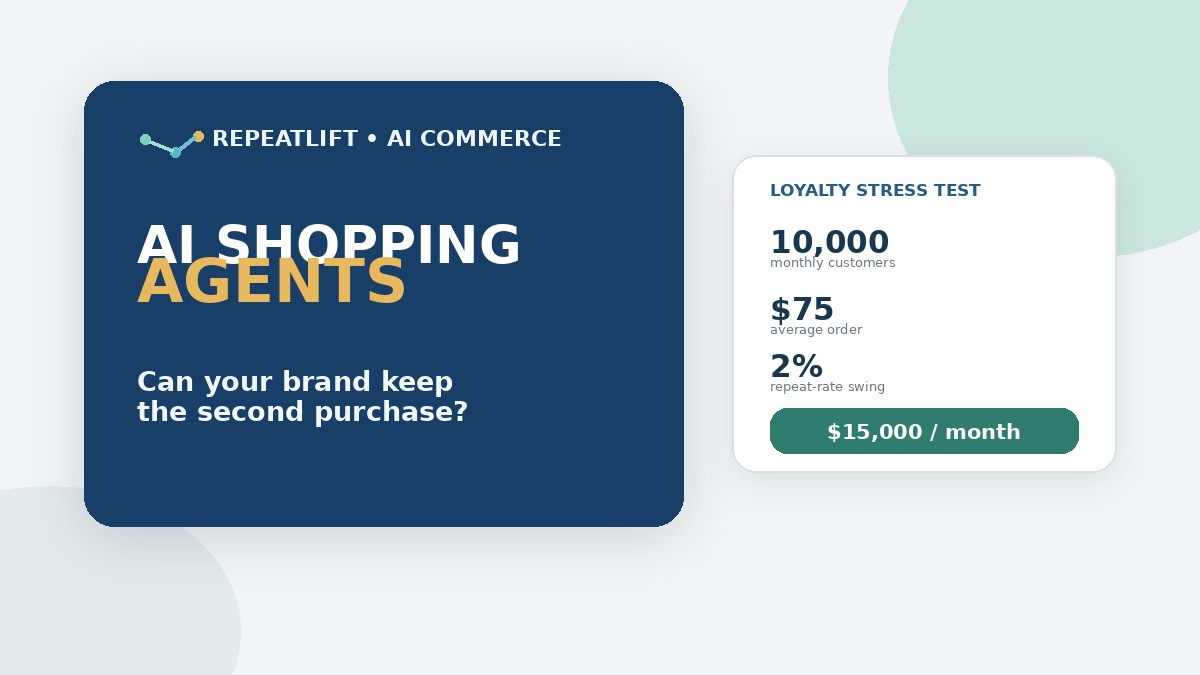
Imagine your store serves 10,000 customers in an average month and your average order value is $75.
You do not know yet whether AI-led shopping will improve or weaken repeat purchasing. So do not pretend you know. Run a sensitivity test.
| Repeat-purchase swing tested | Customers represented | Monthly revenue represented | Annualised scenario* |
|---|---|---|---|
| 2% | 200 | $15,000 | $180,000 |
| 5% | 500 | $37,500 | $450,000 |
| 10% | 1,000 | $75,000 | $900,000 |
*Illustrative sensitivity analysis, not a forecast. The annual figure assumes the same monthly scenario repeats for 12 months and does not deduct product costs, fulfilment, returns, discounts or other expenses.
The value of this exercise is not the big annual number. It is knowing the size of the behaviour you are trying to defend.
If a two-point change represents $15,000 of monthly sales in your business, “AI customer retention” stops being a vague trend topic. You now have a reason to measure the cohort properly.
Run the same stress test with your numbers
Enter your monthly customer count and average order value, then test 2%, 5% and 10%. Treat the result as the revenue associated with that repeat-purchase swing — not a prediction.
How to measure AI-referred customer retention without fooling yourself
This is where many ecommerce teams will get the story wrong. They will look at AI conversion rates, see a strong first order and declare the channel a success.
Acquisition quality is not only “did they buy?” It is “what happened after they bought?”
Separate identifiable traffic from ChatGPT, Perplexity, Gemini, Copilot and other AI referrers where your analytics allows it. Keep in mind that some AI-assisted journeys can still be classified as organic traffic, so treat attribution as directional rather than perfect.
A channel can look excellent because loyal customers are using AI to find products they already intended to buy. If you want to judge acquisition quality, isolate genuinely new customers.
Do not wait for a generic annual retention report. Pick windows that fit your product’s normal repurchase cycle and compare AI-referred buyers with organic, paid social, paid search and direct customers.
Track AOV, gross or contribution margin, returns, shipping subsidies, loyalty rewards and any second-order discount. A repeat order that requires aggressive discounting may be less valuable than it looks.
If AI-originated customers repeat at the same rate but take twice as long to come back, that changes cash flow and the timing of your retention spend.
Does the second order contain a natural complement, a refill, a replacement or just another discounted hero product? That tells you whether the relationship is becoming useful or remaining purely price-led.
Seven practical ways to protect loyalty as AI shopping grows
1. Make the second purchase part of the first-order plan
Before you chase more AI visibility, decide what a sensible second order looks like. If you sell skincare, it might be replenishment or a complementary routine product. If you sell electronics, it could be an accessory, warranty, consumable or service. If you sell gifts, the repeat event may be the next occasion rather than the same item.
If you cannot name a credible second purchase, your retention plan is not ready — regardless of the acquisition channel.
2. Preserve customer recognition at checkout
The post-purchase relationship is much harder if the customer arrives through a new interface and you cannot reliably recognise them later. Use your commerce platform’s normal account, order-history and consented communication tools well. Make it easy for customers to identify themselves without forcing unnecessary friction.
3. Give the customer a reason to come back to you, not just to the category
“10% off your next order” is not a loyalty strategy. Sometimes it is a useful test, but it does not tell you whether the customer prefers your business.
Better reasons depend on the product: saved sizing or compatibility, faster replenishment, useful how-to content, bundles that solve the next problem, easier returns, loyalty credit, early access, service history, guarantees or genuinely better support.
4. Make loyalty value understandable to machines as well as humans
If your best customer value is buried in a banner image or vague marketing copy, an AI system may not understand it. Product names, attributes, prices, availability, variants, shipping terms and structured product data should be accurate and machine-readable.
This is not “SEO for robots instead of people.” It is making the commercial facts of your offer clear enough to survive a new discovery interface.
5. Do not hide the advantages that make repeat purchase rational
If members get free shipping after the second order, say exactly how it works. If refills cost less, make the saving explicit. If accessories are guaranteed compatible, structure that information clearly. Loyalty is stronger when returning has an obvious practical benefit.
6. Protect margin before buying retention with discounts
If your response to weaker loyalty is a bigger second-order coupon, calculate the margin first. A store can “improve retention” while quietly teaching customers to wait for discounts.
Before adding a retention discount, check the economics
Use the Profit Margin Calculator to see what your margin looks like after product cost and the price you actually plan to charge.
7. Treat AI as a channel, not a customer type
An AI-referred visitor is still a person with a reason for buying. Some will be deal seekers. Some will be high-intent shoppers who used AI to cut research time. Some will already know your brand.
Do not send the same “AI customer” flow to everyone. Segment by first-time status, product, order value, acquisition context and actual repeat behaviour.
The retention play changes by what you sell
Consumables & replenishment
Your advantage is timing. Make reorder intervals, pack sizes and compatibility clear. Measure whether AI-originated buyers opt into reminders or return around the normal replenishment window.
Durable or high-ticket products
Do not judge loyalty only by buying the same product again. Measure accessories, services, warranties, referrals and category expansion. A 12-month repurchase window may be more meaningful than 30 days.
Fashion & choice-heavy retail
Saved fit, sizing confidence, returns experience, wish lists and preference data can create real switching costs that are useful to the customer — not artificial lock-in.
Gifting & occasion-led stores
The “repeat” event may be a birthday, Christmas, Mother’s Day or another recipient. Capture the occasion and build a useful reminder cycle rather than pushing an immediate second purchase.
What not to do because “agentic commerce is coming”
- Do not assume every AI referral is an autonomous agent purchase. Most measurable activity today still includes human-controlled discovery and click-through.
- Do not rebuild your entire stack around one AI platform. The ecosystem is still fragmented and standards are evolving.
- Do not judge AI traffic only on first-order ROAS or conversion. Add repeat behaviour and margin to the scorecard.
- Do not respond to loyalty risk with permanent discounts. You may improve purchase frequency while damaging contribution margin and price expectations.
- Do not ignore AI discovery because organic search is still bigger. Shopify says organic remains the dominant source, but AI referrals are growing quickly enough to deserve a measured test.
A simple 90-day AI loyalty test for an ecommerce team
Weeks 1–2: establish the baseline
- Record total customers, AOV, repeat purchase rate and contribution margin.
- Identify which AI referrers your analytics can reliably show.
- Document your normal 30/60/90-day second-purchase rates by channel.
- Run 2%, 5% and 10% RepeatLift scenarios so you know what movement is commercially meaningful.
Weeks 3–6: improve the first-to-second-order bridge
- Choose the most logical next purchase for your top acquisition products.
- Fix unclear product attributes, compatibility, shipping and return information.
- Review post-purchase emails and make them useful before promotional.
- Test one non-discount reason to return and one controlled incentive.
Weeks 7–12: compare cohorts
- Compare AI-referred first-time buyers with organic and paid cohorts.
- Measure second-purchase rate, time to repeat, AOV, margin and returns.
- Look for product-level differences: which first products create the best next order?
- Scale only the retention tactics that improve both repeat behaviour and economics.
The scorecard I would use
Keep it small enough that someone actually looks at it every month:
| Metric | AI-referred | Organic | Paid | Why it matters |
|---|---|---|---|---|
| Conversion rate | Track | Track | Track | First-order intent |
| First-time customer share | Track | Track | Track | True acquisition mix |
| Average order value | Track | Track | Track | Order quality |
| 60-day second-purchase rate | Core | Core | Core | Retention quality |
| Contribution margin | Core | Core | Core | Real economics |
| Returns/refunds | Track | Track | Track | Low-quality demand signal |
If AI traffic converts better but repeats materially worse, you have a retention problem. If it converts better and repeats just as well, it may be an unusually valuable acquisition source. If it repeats better too, the story is stronger still.
The point is to let the cohort tell you what is happening instead of deciding in advance that AI traffic is either wonderful or dangerous.
The bottom line: win the order, then prove you can keep the customer
AI is making product discovery faster and more specific. That can be good news for merchants with strong products because high-intent shoppers can reach the right product page sooner.
But a faster first purchase does not automatically create a stronger customer relationship.
In 2026, the practical advantage is not predicting exactly how agentic commerce will work in three years. It is building the measurement habits now: know who the customer is, know what their second purchase should be, track whether they make it, and know what a small change in that behaviour is worth.
That gives you something far more useful than an AI-commerce prediction: a number you can act on.
How much repeat revenue is a small rate change worth to you?
Use your own customer count and average order value. Test a few repeat-rate scenarios, then decide how much attention retention deserves.
Sources and methodology
- Shopify — AI-referred shoppers convert better and spend more (11 May 2026). Used for Q1 2026 AI referral, order, conversion, AOV and product-page landing data.
- Adyen — Agentic commerce: how businesses can move forward without giving up control (25 February 2026). Used for customer-relationship, control and discovery-vs-checkout context.
- Visa — Agentic commerce and Visa Intelligent Commerce Connect. Used for definitions and merchant relationship/data considerations.
- Mastercard — Agentic token framework. Used for returning-customer identity and loyalty-retention context in agent-mediated commerce.
RepeatLift calculations are illustrative sensitivity scenarios, not predictions of how AI will affect your business. Revenue figures are before costs and do not constitute financial advice.
Frequently asked questions
What is an AI shopping agent?
An AI shopping agent is software that can help a shopper discover, compare and, in some cases, purchase products based on instructions. In 2026, it is important to distinguish AI-assisted discovery from fully autonomous checkout: much of the traffic merchants can measure today still involves a person clicking through and completing the purchase.
Will AI shopping agents reduce customer loyalty?
Not automatically. AI can make products easier to compare and can reduce the amount of brand-controlled browsing before a purchase, which may weaken loyalty for some merchants. But AI-referred customers can also be high-intent buyers. The useful answer comes from comparing their second-purchase behaviour with other customer cohorts.
How do I measure retention from AI-referred traffic?
Create a cohort of identifiable AI-referred first-time customers and compare second-purchase rate, time to second order, AOV, contribution margin and returns at a window that makes sense for your category, such as 30, 60 or 90 days.
How do I calculate the revenue impact of a 2% change in repeat purchases?
For a simple scenario, multiply your customer count by 2%, then multiply that number by average order value. For example, 10,000 customers × 2% × $75 equals $15,000 of monthly revenue associated with that repeat-purchase swing. It is a sensitivity model, not a forecast.
Should ecommerce brands optimise for AI shopping now?
Prepare, but do not overreact. Keep product data clear and structured, make your offer understandable, preserve customer recognition and start measuring AI-referred cohorts. At the same time, organic search remains a major discovery channel, so AI preparation should complement rather than replace proven acquisition work.