
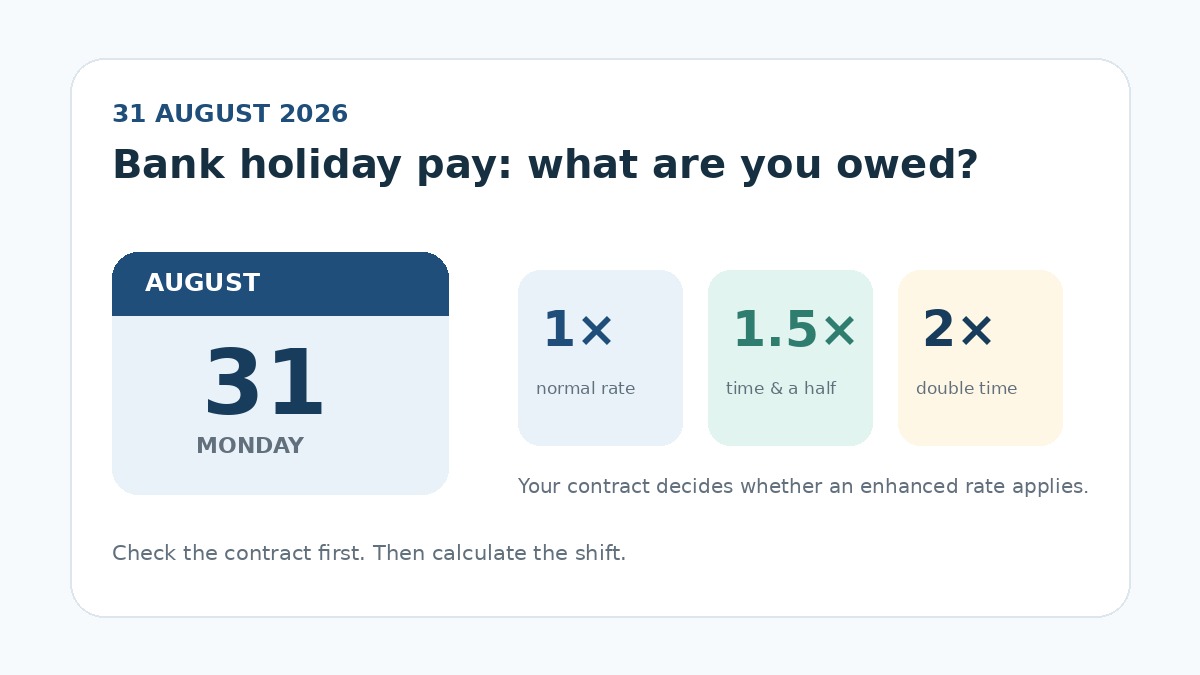
Bank holiday shifts create the same question every year: “If I work, do I get paid extra?” Many workers expect a legal double-time rate, but UK rules are more dependent on the contract than that.
The practical way to deal with the shift is simple: confirm whether you are required to work, find the rate in your contract, identify whether any time off in lieu applies, then calculate the total before agreeing to extra hours.
When is the August bank holiday in 2026?
For England and Wales, the summer bank holiday falls on Monday 31 August 2026. The same date is listed for Northern Ireland. Scotland's summer bank holiday was earlier, on Monday 3 August 2026, so workers in Scotland should check the holiday calendar and their local arrangements separately.
Do you legally get extra pay for working a bank holiday?
There is no general legal rule requiring an employer to pay a higher hourly rate simply because the shift falls on a bank holiday. GOV.UK states that employers do not have to pay workers for overtime, although average pay for total hours worked must not fall below the applicable National Minimum Wage. Your employment contract will usually set out overtime rates.
GOV.UK also states that bank or public holidays do not have to be given as paid leave. An employer can include bank holidays within statutory annual leave entitlement.
That means the phrase “bank holiday” alone does not tell you the rate. Your contract, staff handbook, collective agreement or written workplace policy is the key document.
Search for wording such as “bank holiday working”, “public holiday”, “overtime”, “premium rate”, “enhanced rate”, “time and a half”, “double time” or “time off in lieu (TOIL)”.
What do normal pay, time-and-a-half and double time mean?
- Normal rate (1×): your usual hourly rate.
- Time-and-a-half (1.5×): your usual hourly rate multiplied by 1.5.
- Double time (2×): your usual hourly rate multiplied by 2.
If your hourly rate is £15, time-and-a-half is £22.50 per hour and double time is £30 per hour. For an eight-hour shift, that would be £180 at 1.5× or £240 at 2×.
| Hourly rate | 8h at 1× | 8h at 1.5× | 8h at 2× |
|---|---|---|---|
| £12.00 | £96.00 | £144.00 | £192.00 |
| £15.00 | £120.00 | £180.00 | £240.00 |
| £18.00 | £144.00 | £216.00 | £288.00 |
| £20.00 | £160.00 | £240.00 | £320.00 |
Calculate your bank holiday shift
Enter your normal hourly rate, overtime multiplier and hours worked to see the gross extra pay.
Three common bank holiday pay scenarios
Scenario 1: your contract says normal rate
You normally earn £15 an hour and your contract does not provide an enhanced bank holiday rate. If you work eight paid hours at your normal rate, the gross pay for those hours is £120. Depending on your normal schedule and salary arrangement, that may already be included in your regular pay rather than appearing as an extra payment.
Scenario 2: your contract says time-and-a-half
At £15 an hour, the bank holiday rate becomes £22.50. Eight hours produces £180 gross for the shift. If the contract describes this as an additional premium rather than the total rate, check the wording carefully—some payroll systems show base pay and the premium as separate lines.
Scenario 3: your contract says double time plus TOIL
Some employers offer both enhanced pay and a day off in lieu; others offer one or the other. This is a contractual benefit, not something to assume. If your rate is £18 and the contract genuinely provides 2× for eight hours, the gross shift value is £288, before deductions, plus any separately stated leave entitlement.
What if you are salaried rather than hourly paid?
A salaried worker can still have bank holiday rules in the contract. The key questions are whether bank holiday work is already part of normal contracted hours, whether the salary includes a premium, whether additional hours are paid separately and whether TOIL is offered.
If you need an hourly figure for comparison, use the Hourly to Salary Calculator in reverse conceptually: divide the annual salary by the contractual paid hours for the year. But for payroll entitlement, use the method your contract or employer specifies rather than inventing an hourly rate yourself.
Five questions to ask before the shift
Bank holiday pay checklist
- Am I contractually required to work this bank holiday?
- Is the rate normal pay, 1.5×, 2× or another premium?
- Does the stated multiplier represent the total rate or an extra premium on top of base pay?
- Will I receive time off in lieu, and if so, when can I take it?
- How many of the shift hours are actually paid after unpaid breaks?
Ask these questions before the shift if possible. It is much easier to resolve a rate discrepancy when everyone agrees on the terms in advance.
What if your bank holiday pay looks wrong?
Start with the payslip and the written terms. Compare the number of paid hours, the base rate, the multiplier and any separate premium line. If the figures still do not match the contract, ask payroll or your manager for the calculation in writing.
If the issue is about employment rights rather than a simple payroll error, GOV.UK directs workers to Acas for free and confidential advice on working hours. Keep copies of the relevant contract wording, rota, timesheet and payslip.
Does a bank holiday have to be an extra paid day off?
No. GOV.UK says bank or public holidays do not have to be given as paid leave, and an employer can choose to include bank holidays as part of statutory annual leave. The important question is how your employer structures your overall holiday entitlement and what your contract says.
This is separate from the question of an enhanced rate for working. A workplace can, for example, include bank holidays in annual leave but still offer premium rates when staff are rostered to work them—or it may not. Do not combine the two questions.
Official sources
- GOV.UK — UK bank holidays, including the 31 August 2026 date for England and Wales and Northern Ireland.
- GOV.UK — Overtime: your rights, covering overtime pay and contract terms.
- GOV.UK — Holiday entitlement, including the treatment of bank/public holidays.
This article is general educational information, not legal advice. Employment terms can vary by contract and circumstances.
Frequently asked questions
Do I get double pay on the August bank holiday?
Not automatically. Double pay applies only if your contract, collective agreement or workplace policy provides it. UK law does not create a general double-time entitlement just because the shift is on a bank holiday.
Is time-and-a-half compulsory on a bank holiday?
No general rule makes 1.5× compulsory. Check the written overtime or bank-holiday terms that apply to your job.
Can my employer make me work on a bank holiday?
Whether you are required to work bank holidays depends on your employment terms and working arrangements. Check the contract and rota; if there is a rights dispute, seek appropriate employment advice.
How do I calculate bank holiday overtime?
Multiply your normal hourly rate by the contractual multiplier, then multiply by the number of paid hours. For £15/hour at 1.5× for eight paid hours: £15 × 1.5 × 8 = £180 gross.